Prairie Dogs Are Serial Killers That Murder Their Competition
By Michael Greshko PUBLISHED March 22, 2016
The herbivorous rodents kill off competing ground squirrels—the first such behavior seen in a mammal, a new study says.
A white-tailed prairie dog (Cynomys leucurus) clutches onto a Wyoming ground squirrel (Urocitellus elegans) that it had just killed.
Photograph by John Hoogland
On the hardscrabble lands of the American West, blood is spilled by the most innocent-looking of outlaws—the white-tailed prairie dog. These social rodents, native
to Colorado, Wyoming, Utah, and Montana, ruthlessly bite and
thrash Wyoming ground squirrels to death, leaving their bloody bodies to
rot, a new study says. The killers' offspring then live longer, healthier lives—probably because their parents bumped off their competition for food. It’s
the first time that a herbivorous mammal has
been seen killing competitors without eating them, suggesting that a
plant-based diet doesn’t preclude mammals from having a taste
for bloodsport. “In my 43 years of research, this is
perhaps the most provocative, puzzling, and far-reaching discovery I’ve
ever made,” says study co-author John Hoogland of the University of Maryland Center of Environmental Sciences. “The results are just staggering.”
Cracking the Case
Like many murder mysteries, Hoogland’s study began with a body dumped in a quiet landscape: the scrublands of western Colorado’s Arapaho National Wildlife Refuge, where Hoogland and his students studied prairie dog behavior from 2003 to 2012 with a devotion bordering on the fanatical. “For
four months every year, we live like prairie dogs,” says Hoogland, a
National Geographic grantee. “We get to the colony early in the morning
before the prairie dogs wake up, we sit in towers all day watching what
they do, and we stay until the last prairie dog submerges, just around
sunset.” During his 2007 field season, Hoogland spotted a
white-tailed prairie dog tossing around a young rodent. Initially, he
suspected that it was killing another prairie dog’s pup, which is not
surprising: Infanticide is common in other prairie dog species, though it has never been observed in white-tailed prairie dogs.
Prairie Dog Alarms
When danger lurks, the
prairie dog males fend for themselves, but the females look out for the
community.
But once Hoogland examined the prairie
dog’s victim up close, he realized that it was in fact a Wyoming ground
squirrel, a species that eats the same grass and prickly pears
as prairie dogs. “I got out a walkie-talkie right away, and I
said to my students, ‘Hey, we gotta watch to see if there are any more
[killings]!’” he says.
Killer Supreme
Over the next five
years, Hoogland and his students built dossiers on 101 ground squirrel
murders, plus 62 suspected cases. Most murders occurred in May, when
young ground squirrels emerged from their nests and began foraging. The researchers identified 47 killer prairie dogs—both male and female, and always adults.
One
prairie dog, nicknamed Killer Supreme, slew nine ground squirrels in a
four-year killing spree. Another massacred seven juvenile ground
squirrels in a single day.
But comparing
survival rates of non-killers' and killers' offspring revealed a method
to the madness: Killers' offspring had better survival odds than
those of non-killers, presumably because they had more to eat. And shockingly, a prairie dog’s penchant for murder was the only factor that predicted its offspring’s success. (See "Friends For Dinner: Why Some Animals Become Cannibals.") “The
condition of the female, her longevity—the factors that normally
influence [success]—none of them apply to this case,” says study
co-author Charles Brown of the University of Tulsa. “It seems to me is that there are major, major benefits to killing these ground squirrels.”
Unappetizing Demise
The study, published Tuesday in Proceedings of the Royal Society B, adds
a demented twist to scientists’ understanding of interspecific
competition—the struggle among different species for shared resources
such as food. It’s not unheard of for this competition to provoke
aggression, or even death: Some animals dine on competitors on the same
food chain level. Even herbivorous mammals such as rats will take on
other prey opportunistically, sometimes eating eggs, birds, and one
another, according to John Orrock of the University of Madison-Wisconsin. (See "Why Do Animals Sometimes Kill Their Babies?") But tellingly, white-tailed prairie dogs don’t eat their kills. Hoogland notes
that they occasionally gnaw at the squirrels’ chests, or nibble at
their brains, but just to ensure that the squirrels are definitively
dead. The prairie dogs then abandon the squirrels’ broken carcasses,
which nearby birds then scavenge. “They’re killing for the sake of
killing—not killing to achieve some nutritional benefit," says Orrock,
who wasn’t involved with the study.
Murky Motives?
Despite the fact that
scientists have caught killer prairie dogs red-handed, however, the
animals’ motives aren't completely understood. The weight of the evidence shows that murderous prairie dogs have longer-living children when they kill ground squirrels. But more
research will need to eliminate a more remote possibility: that killer
prairie dogs may just happen to live in areas with richer vegetation,
which would attract more ground squirrels and trigger more conflicts
over food, say the study's authors. Regardless, the results
suggest that for herbivores of all stripes—including white-tailed
prairie dogs and ground squirrels—competition won't just
bring hardship. For many, there will be blood.
By : Gari Sumber http://news.nationalgeographic.com
1. In terms of development, the first year of a cat’s life is equal
to the first 15 years of a human life. After its second year, a cat is
25 in human years. And after that, each year of a cat’s life is equal to
about 7 human years.
2. Cats can rotate their ears 180 degrees.
3. The hearing of the average cat is at least five times keener than that of a human adult.
4. In the largest cat breed, the average male weighs approximately 20 pounds.
5. Domestic cats spend about 70 percent of the day sleeping. And 15 percent of the day grooming.
6. A cat cannot see directly under its nose.
7. Most cats have no eyelashes.
8. Cats have five toes on each front paw, but only four on the back
ones. It’s not uncommon, though, for cats to have extra toes. The cat
with the most toes known had 32—eight on each paw!
9. Some believe that if you dream about a white cat, good luck will follow.
10. Meows are not innate cat language—they developed them to communicate with humans!
Sumber : www.catchow.com
By : Gari
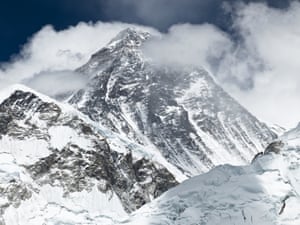
On Everest: meet the people scaling the world's highest peak
Everest base camp, May 2016.Photograph: Mathias Braschler & Monika Fischer
My name is on the first list. Twenty years ago, in the fabled (and fatal) season of 1996, I summited Everest from the northern side.
It felt pretty wild to be up there. On our summit day, there was not a
single footprint to be seen on the final ridge. As I reached for the
summit pole, decked with fluttering Buddhist prayer flags, the tears
were freezing solid on my cheeks. I became the fifth Briton to climb
Everest from this side, the same route which killed mountain pioneers George Mallory and Andrew Irvine in 1924.
Climbers
talk about “feeding the rat” – their hunger for risk, for challenge,
for fear. Everest still delivers that. Our water bottles had frozen in
the crushingly cold temperatures you hit at 8,000 metres and beyond,
committing us to a 16‑hour summit day without fluid. In the final hour
of an epic retreat to the high camp – my oxygen bottle out of gas, my
body close to critical dehydration, physical exhaustion shutting down
muscles I didn’t even know existed – I could not remember my own name
nor the name of the mountain I was on.
The margins get terribly thin up there. I came back down with
four minutes of summit footage and two frostbitten fingers. My rat was
happy, for a while. Nine days earlier, a massive storm had swept the
mountain, killing eight climbers,
the worst loss of life on a single day on the mountain up to that
point. A total of 15 people died that spring. The rollercoaster ride of
folly and survival described so vividly by climber Jon Krakauer in his
book Into Thin Air drove itself deeply into the American consciousness – so deeply that it was recently turned into a major Hollywood film. The mountain has become bigger than itself.
This year I was back on Everest, as writer in residence for the Sheffield-based expedition company Jagged Globe. We flew into the rugged airstrip of Lukla,
a white-knuckle experience in its own right. There weren’t many
trekkers around this time; tourism and megaquakes don’t sit well
together. A night in a cosy Nepali teahouse loses some of its charm when
you know the rock walls around you have only just been rebuilt, and the
hefty beams over your head are still splintered right through.
Gyalsen Dorjeo, 28, a veteran of four Everest summits, and a rope-fixing
sherpa for a group who summited on 13 May 2016, interviewed below.
Photograph: Mathias Braschler & Monika Fischer
Climbers,
of course, are made of sterner stuff. When we arrived, 34 teams were
hauling their tons of gear up to base camp, and 289 summit permits had
been issued. Roughly 700 sherpa support workers – high-altitude
climbers, porters, ice fall doctors, cooks – were also on their way up.
Then there are the lodge workers, the yak drivers, the helicopter pilots
and the shopkeepers in the villages along the way. Countless Nepali
families depend on Everest for their livelihood.
Is it strange that climbers continue to come even as the fatalities rise? Veteran Everest blogger Alan Arnette
has spotted a revealing trend. “Everest seems to attract more climbers
after a tragic year,” he wrote recently. “The years following the
largest death tolls to date – in 1996, 2006 and 2014/15 – were followed
by a record number of climbers. The more Everest takes lives, the more
people come.”
Who are they, these individuals who travel half way around
the world to risk their lives in a game of high-altitude roulette? Are
they the same people who run with the bulls at Pamplona,
who go wing-suiting out of helicopters at the weekend? Are they
adrenaline junkies and ego-trippers looking for a £45,000 thrill?
Not
if the climbers I was with were anything to go by: Ian, Mary, Nick,
Richard, Steve, a hundred years of mountain experience between them,
grounded, extremely fit and savvy. Almost 400 British climbers have
ascended Everest to date, but that wasn’t going to put them off. For
them, it would be a first.
They were matter of fact about the
risks. Nick Talbot, for instance, was not only returning to Everest
after sustaining serious injuries in the previous year’s earthquake, he
was doing so with lungs damaged by cystic fibrosis. I asked Nick to
estimate how much less lung function he had than the other team members,
and he said 15%. Up there, at 8,848 metres, that 15% could easily mean
the difference between life and death. But Nick summited
– as did Steve and Mary – in the company of David Hamilton, an
impressive leader from Glasgow who has now been “up top” an astonishing
eight times. They were assisted by five sherpa climbers under the
direction of Sirdar Pem Chhiri. As is the case with all commercial
expeditions, the sherpas had taken on the lion’s share of load carrying
and trail breaking.
Money can’t buy a place in an Olympic 100m sprint, but it can buy the
chance to reach Everest’s peak. Photograph: Mathias Braschler &
Monika Fischer
The chat around the mess tent table was about the biggest
change of all – towards sherpa-led and sherpa-owned expeditions. “All
the western teams will be out of here within the next 10 years,” one
expedition leader told me. “We’re approaching the end game. The local
guys can do this for half price and they’ve got the expertise.”
What
do you get for your money? You get no guarantees, but there is a grungy
glamour to climbing Everest. You may well find yourself rubbing
Gore-Tex-clad shoulders with the elite of the mountain world. Climber Melissa Arnot (six
times on the Everest summit, and the first American woman to reach the
top without oxygen) and Ueli Steck (twice winner of the Piolet d’Or,
climbing’s ultimate prize) walked casually into the dining room of our
lodge one night, causing the chatter to fall away to a star-struck hush.
Money can’t buy you a place on the starting blocks of an Olympic 100m
sprint, but it can buy you a place at Everest’s top table.
For
such a big mountain, it’s ironic to see how important the small print
has become on the contracts that bind climbers to their expedition
companies. These days, writs flutter about the slopes of Everest like
the crows that make a healthy living from base camp scraps. Very wealthy
people can get angry when they don’t get what they think they’ve paid
for, or when nature demonstrates that she cannot be tamed.
Accusations
of cheating also roll around, with all the predictability of the annual
monsoon. In the closing days of each climbing season, there are fewer
eyes around to scrutinise summit claims. This year an Indian couple were accused by other mountaineers of faking a summit shot. Such disputes are rarely resolved.
Everest
keeps its secrets. And that rat is still up there – waiting patiently,
with glittering eyes, calling those, like myself, who are too foolish to
resist. I am planning to return in 2017. Watch this space.
Introduction by Matt Dickinson, author of The Everest Files, a series for young readers published by Vertebrate Publishing.
Meet the climbers
Richie Hunter, 31, mountain guide from New Zealand on
his first ascent. He and the group interviewed below summited on 13 May
2016
The challenge for me is to maintain momentum for all
the climbers. It’s not just sleeping and eating well, I need to make
sure they’re mentally engaged. If the guides don’t give off a positive
vibe, they’ll pick up on it.
You become a close family; I build a
trust and rapport with each climber. We’ll often have a heart-to-heart
and talk about important personal things. When people are maxed out,
their history comes alive. Often that’s a reason they’ve come. But not
everyone has a sob story and I don’t want to encourage that, because
that’s not what Everest is about. It’s not recovery or therapy; it’s the
biggest challenge of their lives and people work really hard to get
here
Greg Paul, 61, entrepreneur from Utah, US
I’ve
been trying to get to the world’s highest point for four years. It’s
been a lifelong dream; I’ve spent all my savings and had both knees
replaced.
In April 2014, my attempt was aborted by the Khumbu
icefall. I started to feel it was my lot in life to enjoy the journey
but never make it to the top, yet I had confidence in my sherpa, Nawang
Tenjing.
Friday 13, the day I summited, will always be lucky for
me now. We were the first in our group to summit. It was so windy we had
to sit down so we didn’t get blown over. We hugged, and I was just
stunned to be there, given the weather. We were in a whiteout, a windy
snow storm on the highest mountain in the world. I wanted to take
pictures, but didn’t dare take the camera out.
I’ve known Nawang since 2012. I got to know him on Ama Dablam
in Nepal. It can be hard to get to know people here: you feel awestruck
by the surroundings and everything is overwhelming. I got to know him
better the following year; we didn’t have much language in common, but
we had movie nights at base camp watching Indiana Jones and Tomb Raider.
When last year’s earthquake destroyed Nawang’s family home, I helped
raise money. I felt it was the least I could do. I’m hoping he’ll be
able to come to Utah in the winter. I’ve got him taking English lessons
and we practise on Skype.
Tracee Metcalfe, 42, doctor from Colorado, US
Other
climbers can push themselves to the limit, but I have to be careful and
stay aware of my exhaustion levels. Normally a doctor doesn’t go to the
summit, so they’re rested. The best place for them to be is base camp,
so they can communicate by radio; it was unusual that I got to do this.
My
duty is to keep the climbers and sherpas healthy; there’ll either be
nothing for me to do or a whole lot. I always worry a disaster will
happen and I’ll have 10 injured people.
At base camp, it’s bloody
noses and blisters, and someone always seems to get a boil on their butt
because their backpack is rubbing. Many sherpas don’t have access to
dental care. I’m not a dentist, but often antibiotics do the trick. I
see a lot of colds and there’s a dry, high-altitude cough we call the
Khumbu cough.
The lack of oxygen and the cold, harsh environment
make it hard for people to heal properly, and you’re out of breath just
walking around. Someone who has never been in these conditions before
would find that extremely hard. But we have hot meals three times a day,
and a shower – even if it’s temperamental.
Jaco Ottink, 42, Dutch business manager living in Sydney
When I was 23, I climbed my first of the world’s “seven summits”,
in Alaska. I wasn’t thinking I’d climb every summit, it was more that I
love the mountains and it’s somewhere I can be by myself. But it has
been a dream to climb Everest. It’s not like I want to be away from my
family – I’ve got three kids – but once in a while it’s good to do
something for yourself. I had 2,000 photos of them on my phone to look
at and certain songs I’d listen to, like U2’s I Still Haven’t Found What I’m Looking For.
Everest
is, by far, the most challenging summit, and more mentally than
physically, because of the duration; it takes 50 days. When you start at
base camp, you might have some knowledge of Everest – but when you’re
actually there, it’s 100% different. It’s fascinating walking the first
stage, through the Khumbu icefall: you’re walking through ice bricks
which can be between a metre and 50m high, and which can collapse within
a second.
An hour and a half before I reached the summit, it
started to snow and the wind was terrible. My left eye was frozen, so I
tried to put on new goggles, but they froze, too. Five minutes felt like
an hour, and there was a point where I said to my sherpa, “If the
weather is like this, we need to turn around.” I had made a promise to
my family to arrive at the summit, but I had also promised them I would
come home safe.
My sherpa had summited five times before and he
said, “It’s just around the corner, you can go for it.” You build up a
good relationship in a short time, and it’s all about trust. When I
reached the summit, I felt on top of the world. But I could only spend
two minutes up there as the wind was so bad. Then you go down, knowing
that 80% of accidents happen on the way back.
People criticise
climbers for using sherpas and oxygen to get to the summit, but in the
end, it’s my journey. It’s my legs that are moving.
Andreas Friedrich, 54, commercial pilot from Munich, Germany
You
don’t come to Everest and think, “I’ll try to climb it and if it
doesn’t work, I’ll walk away.” I did it fully planning to make it to the
top. It’s a different kind of determination from climbing any other
mountain on the planet. I spent two years training physically and
mentally.
The hardest part wasn’t the summit, it was just before
that, high inside the area called the Death Zone. When I got to the
summit, I was waiting for that feeling of being overwhelmed to replace
the adrenaline, but there were no emotions.
I felt the imminent
presence of death on the way back down. The next campsite was still far
away and there was no one behind me. I was hardly able to walk. I was
totally depleted. It was so tempting to sit down on a boulder and wait
for eternal sleep. But I felt something whip me all the way down. It was
like he was behind me like a shadow, and I had to outperform him.
When
I decided to climb Everest, I knew I needed to establish some kind of
spiritual connection to the mountain, to not only stand on it, but
understand what was driving me to its summit. Since then, I’ve tried to
revisit those last moments before reaching the summit with the help of a
psychologist. Even so, I’m starting to feel the temptation to go back
and climb one more time…
Son Dorjee, 54, Andreas Friedrich’s sherpa, who has 12 Everest summits
I’ve
been a sherpa since 2004 and I like the work, although it’s very
dangerous. I’m always happy to be on top of the world, but this year was
the most difficult, because it was so windy. I was thinking, “We can
get there, but how are we going to come down?” I was nervous. I’m
starting to feel old now, so maybe I’ll only do it two more times.
Phurpa Tashi, 45, head sherpa and a record holder with 21 Everest summits
We
respect the mountains here the way we would respect a god. It’s very
important to our economy that people from other countries come here to
climb mountains. Every time I get to the top, I feel very proud, and
happy to see all the other people who have made it. As a sherpa, each
time is different, whether you’re guiding a climber or fixing the ropes.
I’m always very worried about getting people back to base camp.
Interviews by Mathias Braschler and Martha Hayes.
Sumber : www.theguardian.com
By : Gari
Nyepi
From Wikipedia, the free encyclopedia
Nyepi
Ogoh-ogoh being paraded in Ngrupuk or the Bhuta Yajna Ritual
Nyepi is a Balinese "Day of Silence" that is commemorated every Isakawarsa (Saka new year) according to the Balinese calendar (in 2016, it falls on March 9). It is a Hindu celebration mainly celebrated in Bali, Indonesia.
Nyepi, a public holiday in Indonesia, is a day of silence, fasting and
meditation for the Balinese. The day following Nyepi is also celebrated
as New Year's Day.[1][2] On this day, the youth of Bali practice the ceremony of Omed-omedan or 'The Kissing Ritual' to celebrate the new year. The same day celebrated in India as ugadi.
Observed from 6 a.m. until 6 a.m. the next morning, Nyepi is a day reserved for self-reflection,
and as such, anything that might interfere with that purpose is
restricted. The main restrictions are no lighting fires (and lights must
be kept low); no working; no entertainment or pleasure; no traveling;
and, for some, no talking or eating at all. The effect of these
prohibitions is that Bali's usually bustling streets and roads are
empty, there is little or no noise from TVs and radios, and few signs of
activity are seen even inside homes. The only people to be seen
outdoors are the Pecalang, traditional security men who patrol the streets to ensure the prohibitions are being followed.
Although Nyepi is primarily a Hindu
holiday, non-Hindu residents and tourists are not exempt from the
restrictions. Although they are free to do as they wish inside their
hotels, no one is allowed onto the beaches or streets, and the only
airport in Bali remains closed for the entire day. The only exceptions
granted are for emergency vehicles responding to life-threatening conditions and women about to give birth.[3][4]
On the day after Nyepi, known as Ngembak Geni, social activity picks
up again quickly, as families and friends gather to ask forgiveness from
one another, and to perform certain religious rituals together.
Sanur Beach - deserted at Nyepi. Everything, except emergency services, closes down to observe a day of silence on Nyepi.
Tawur Kesanga, a ritual procession on the eve of Nyepi,
celebrated a day before. The children carry flame torches, that lit
bonfires to symbolically burn ogoh ogoh monster evil spirits.[5][6]
First, The Melasti Ritual is performed 3–4 days beforehand. It is dedicated to Sanghyang Widhi Wasa. The ritual is performed in Pura (Balinese temple)
near the sea (Pura Segara) and meant to purify Arca, Pratima, and
Pralingga (sacred objects) belonging to several temples, also to acquire
sacred water from the sea.
Second, The Bhuta Yajna Ritual is performed in order to
vanquish the negative elements and create a balance with God, Mankind,
and Nature. The ritual is also meant to appease Batara Kala by Pecaruan offering. Devout Hindu Balinese villages usually make ogoh-ogoh,
demonic statues made of richly painted bamboo and styrofoam symbolizing
negative elements or malevolent spirits. After the ogoh-ogoh have been
paraded around the village, the Ngrupuk ritual takes place, which
involves burning the ogoh-ogoh.
Third, the Nyepi Rituals are performed as follows:
Amati Geni: No fire or light, including no electricity
Amati Karya: No working
Amati Lelunganan: No travelling
Amati Lelanguan: Fasting and no revelry/self-entertainment
Fourth, the Yoga/Brata Ritual starts at 6:00 a.m. and continues to 6:00 a.m. the next day.
Fifth, the Ngembak Agni/Labuh Brata Ritual is performed for all Hindus to forgive each other and to welcome the new days to come.
Sixth and finally, The Dharma Shanti Rituals is performed after all the Nyepi rituals are finished.[7]


 Gyalsen Dorjeo, 28, a veteran of four Everest summits, and a rope-fixing
sherpa for a group who summited on 13 May 2016, interviewed below.
Photograph: Mathias Braschler & Monika Fischer